
The European pension landscape is undergoing a structural shift from Defined Benefit to Defined Contribution frameworks. As individual savers shoulder greater personal responsibility for their retirement adequacy, life insurers, Master Trusts and pension providers face a critical operational challenge: member engagement remains persistently low, while customer servicing costs continue to rise.
Digital mobile applications emerged over the last decade as the primary engagement interface for workplace and personal pensions. However, an executive audit of current market capabilities reveals a profound strategic disconnect. Most enterprise pension applications function merely as digital ‘front doors;’ that is, sleek, branded shells that excel at displaying account balances and static projections but fail when members attempt to take financial action.
When a saver attempts to increase their monthly contribution, transfer an old pension pot or adjust their investment strategy, the digital experience often breaks down into Web browser handoffs, repeated authentication requests or paper-based employer notifications. For senior IT and digital transformation leaders across EMEA, this friction is not merely a user experience defect; rather it is a systemic delivery failure that depresses member accumulation, increases operational risk and threatens compliance with stringent regulatory mandates such as the UK Financial Conduct Authority (UK FCA) Consumer Duty and the European Insurance & Occupational Pensions Authority (EIOPA) Open Finance frameworks.
To build high-performing digital pension platforms that deliver measurable business value and improved saver outcomes, enterprise technology leaders must ground their digital roadmaps in empirical behavioural research and modern, API-first architecture.
Empirical Evidence & Synthesis
The evidence reviewed in this article draws on independent market benchmarking, peer-reviewed field experiments and administrative pension data from Europe, Latin America and Australia.
Taken together, these sources address a single question that now confronts pension providers: why do digitally engaged savers so often fail to act on what they learn in the app?
The findings are presented in four parts. They examine the current state of transactional capability across the market, the effect of transaction friction on saver contributions, the behavioural mechanics that support voluntary accumulation, and the risks of unguided investment switching. A regional comparison then synthesises these results with the regulatory and architectural conditions that distinguish high-performing from underperforming applications.
1. The Market Benchmark: The Engagement-to-Action Gap
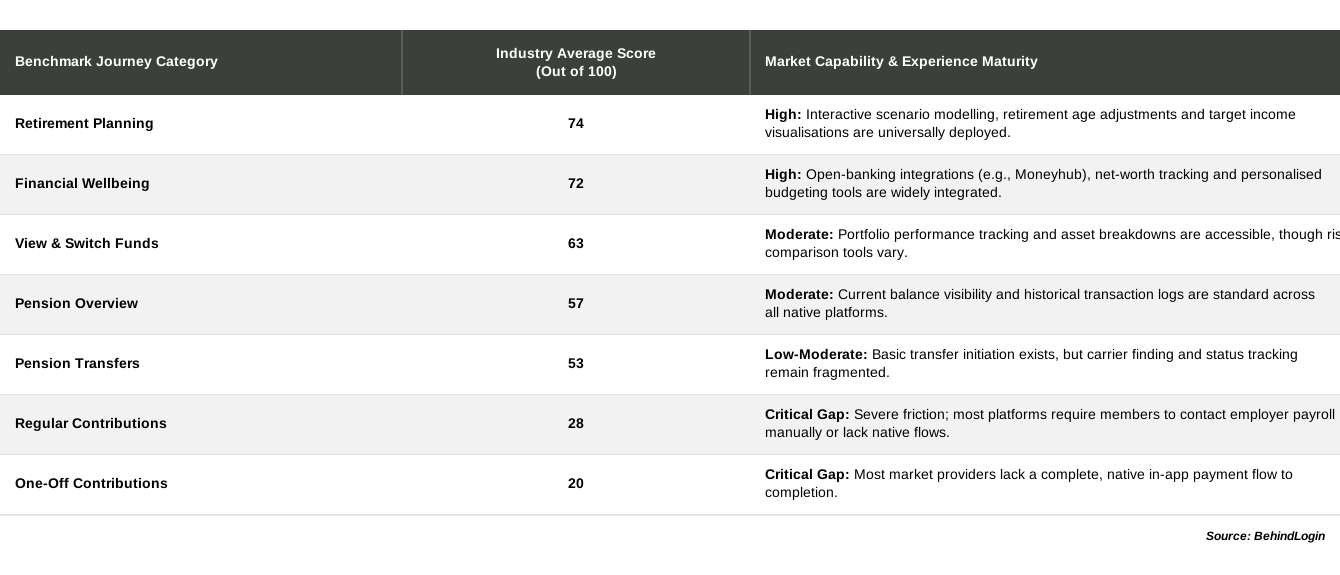
Independent market benchmarking confirms that pension app development has prioritised passive understanding overactive execution. BehindLogin's 2026 Workplace Pension App Experience Benchmark, which evaluated authenticated member journeys across top UK workplace pension providers, highlights a severe structural imbalance in digital maturity (see Figure 1)
This benchmark demonstrates that while technology teams invested heavily in interactive modelling tools, the core transactional pathways that drive balance growth –such as regular salary adjustments and lump-sum top-ups – remain neglected. Members are routinely nudged to understand their retirement gap, only to hit a technical dead-end when they attempt to fix it.
2. Quantifying Transaction Friction: The Hassle Cost Imperative
Empirical research demonstrates that eliminating operational friction, known as ‘hassle costs,’ is exponentially more effective at driving saver contributions than providing financial education or highlighting tax benefits.
A study published in The Review of Financial Studies analysing multi-year Swiss administrative pension fund data evaluated the impact of introducing a dedicated mobile pension application. The rollout of the app increased the annual probability of members making voluntary retirement contributions by 1.8 percentage points (a 65% relative increase over the pre-treatment baseline of 2.8%) and significantly expanded cumulative contributed capita.
To isolate the underlying mechanisms, the researchers conducted a randomised field experiment testing different digital registration reminders, which noted the following experimental findings in terms of “Friction vs. Education:”
- Tax-savings Nudges – Reminders emphasising the app's capability to calculate tax deductions yielded no statistically significant effect on contribution probability or total amounts; and
- Hassle-cost Nudges – Reminders highlighting how the mobile app simplified the contribution process increased the probability of a voluntary contribution by 1 percentage point across the entire population and generated a 38-percentage point increase in contribution likelihood among app adopters, boosting overall contributed capital by 400%.
These findings establish that information deficit is rarely the primary barrier to saver action. Savers are already aware of retirement needs; inaction is driven by complex, time-consuming administrative procedures.
3. Behavioural Mechanics: Personalisation, Visual Framing & Decision Simplicity
Global empirical trials demonstrate that targeted behavioural mechanics embedded directly into mobile UX significantly improve voluntary accumulation:
- Visual Future-self Framing – A randomised field study involving nearly 50,000 account holders on Mexico's government-backed AforeMóvil app evaluated the impact of an interactive "aging filter" that presented users with a digital image of their future retired self. The visual intervention increased the proportion of account holders making voluntary one-time contributions by 16% and expanded total monthly contributed capital by 54%, generating additional savings at a rate nearly 500 times the deployment cost;
- Personalised Timing Reminders – An experimental trial in Colombia with public pension fund Colpensiones showed that monthly mobile reminders tailored to user-specified payday dates significantly increased both the frequency and total volume of voluntary deposits into the BEPS retirement program. The intervention also increased the proportion of users qualifying for free life and disability insurance by 4-percentage points, with demand for reminders driven highest by users who recognised their own forgetfulness; and
- Decision-cost Reduction & Default Framing – Simplifying choice architecture by highlighting clear default contribution paths removes multi-attribute decision complexity, directly unlocking action on voluntary savings enrolment.
4. Investment Switching Dynamics & Volatility Risk
While mobile apps make portfolio management accessible, unguided digital access can induce harmful trading behaviours if not properly architected.
An empirical analysis of defined contribution pension fund members published in the Australian Journal of Management utilising administrative data from Aware Super spanning 2017 to 2021, analysed member investment option switching. The study established that baseline switching activity is low, but spikes dramatically during market downturns. During the COVID-19 market sell-off, for example, switching surged with a heavy skew toward defensive transfers into cash and fixed income.
Crucially, the study proved that reactive market timing destroyed significant account value for switching members compared to non-switching default members. Furthermore, regression analysis showed that non-investment digital activity indices – such as frequent app logins – were stronger predictors of switching activity than account balance. These findings show that high-performing pension apps must combine portfolio visibility with behavioural friction, such as visual impact modelling and cooling-off prompts, to prevent panic-driven asset reallocation during market volatility.
Regional Architectural & Regulatory Comparison
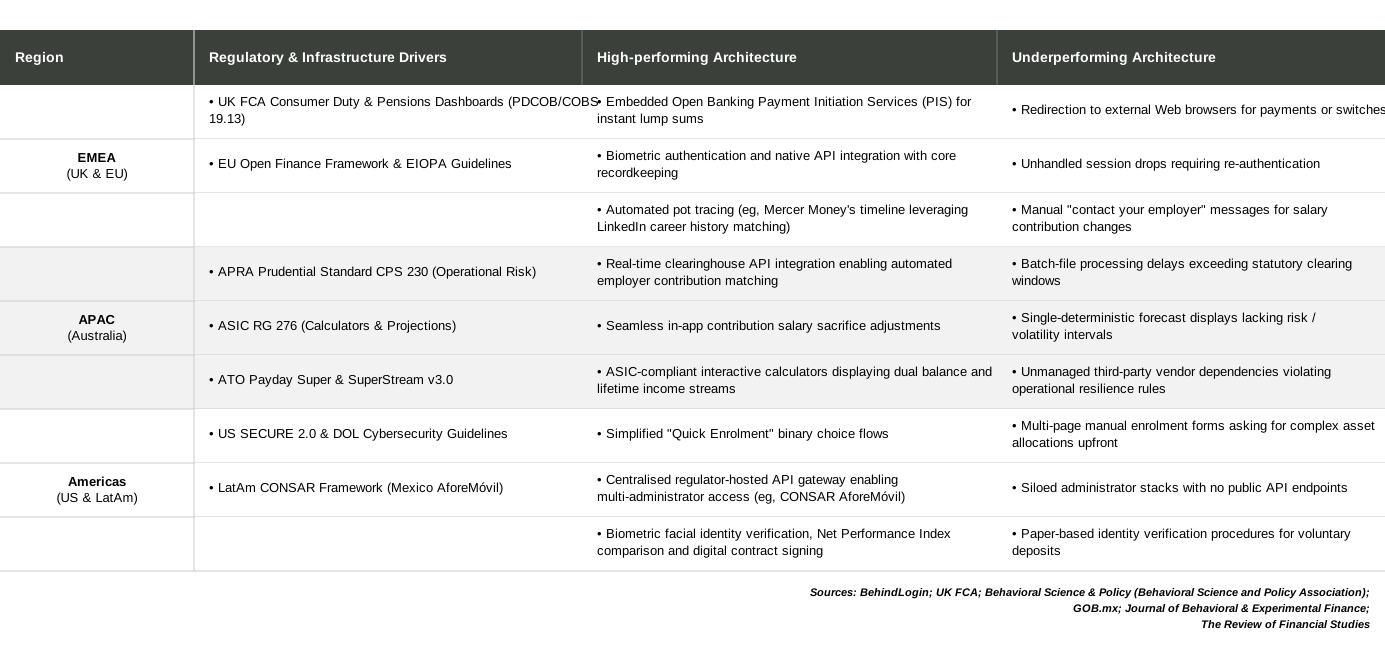
Overall, a synthesis of the findings of the studies and regulatory notices explored in this article shows that high-performing app experiences are defined by how tightly their digital front-ends integrate with underlying clearing infrastructure, payroll systems and regional regulatory frameworks (see Figure 2).
Executive Takeaways
For senior European IT leaders, life insurance executives and digital transformation directors, closing the gap between pension insight and member action requires four strategic initiatives:
- Re-architect the Contribution Pipeline via Open Banking & Payroll APIs – The primary cause of low contribution scores is disconnected backend infrastructure, according to BehindLogin. IT leaders must eliminate manual payroll handoffs by integrating Open Banking PIS for instant one-off contributions and building direct API integrations with Cloud payroll providers. Enabling real-time salary sacrifice adjustments directly inside the native app transforms a multi-week administrative hassle into a single-tap transaction;
- Prioritise Friction Elimination Over Passive Information Provision – Digital product roadmaps must shift capital allocation from decorative modelling tools to low-friction execution pathways. Empirical evidence proves that reducing transaction friction drives a 400% surge in voluntary contribution volume, whereas tax-benefit disclosures yield zero behavioural change. Design every member journey around the principle of minimal cognitive effort, using pre-filled data, biometric signatures and single-screen confirmation flows;
- Deploy Contextual Nudges with Built-in Volatility Guardrails – Incorporate psychologically proven engagement tools such as personalised timing reminders synchronised with payday dates and visual future-self projections within native app screens. Concurrently, protect saver balances by embedding behavioural friction into fund-switching modules. When market volatility triggers elevated login activity, app architecture should automatically display long-term performance contexts and scenario-impact warnings to prevent panic-driven, value-destroying asset switches; and
- In the UK & EU market, Build Modular Infrastructure Ready for Open Finance & Dashboard Ecosystems – With the UK Pensions Dashboards Programme and EU Open Finance regulations establishing mandatory data-sharing standards, providers must decouple their digital front-ends from legacy administration cores. Implementing microservice-based API layers and self-sovereign identity controls ensures full regulatory compliance under UK FCA rules while positioning the enterprise to aggregate third-party financial data and capture consolidated rollover assets.
From Front Door to Transaction Engine: The Likely Evolution of Mobile Pension Architecture to 2029
The evidence reviewed in this article suggests that the central challenge for pension providers is shifting from informing savers to enabling them to act. Benchmark scores of 28 and 20 for regular and one-off contributions, set against scores of 74 and 72 for retirement planning and financial wellbeing derived from BehindLogin’s assessments of different apps indicate that the industry has invested most heavily where the behavioural return is lowest. Over the next one to three years, this imbalance is likely to be corrected as regulatory pressure and competitive differentiation converge on transactional capability.
Three developments appear probable. Specifically:
- Native contribution pathways are likely to become a baseline expectation, with Open Banking payment initiation and direct payroll integration replacing manual employer notifications and browser handoffs;
- The UK Pensions Dashboards Programme, the FCA Consumer Duty and the EU Open Finance framework may together move providers toward modular, API-first architectures that decouple the digital front-end from legacy administration cores; and
- Behavioural design is likely to mature from isolated nudges into an embedded layer of the product, combining payday-timed reminders and future-self visualisation with guardrails that moderate panic-driven switching during market volatility.
Taken together, these shifts indicate that the competitive position of a pension application will depend less on the sophistication of its projections than on the speed and simplicity with which a saver can act. Providers that treat the application as a transaction engine, rather than a front door, are therefore better placed to improve saver outcomes and to demonstrate compliance with evolving supervisory expectations.