
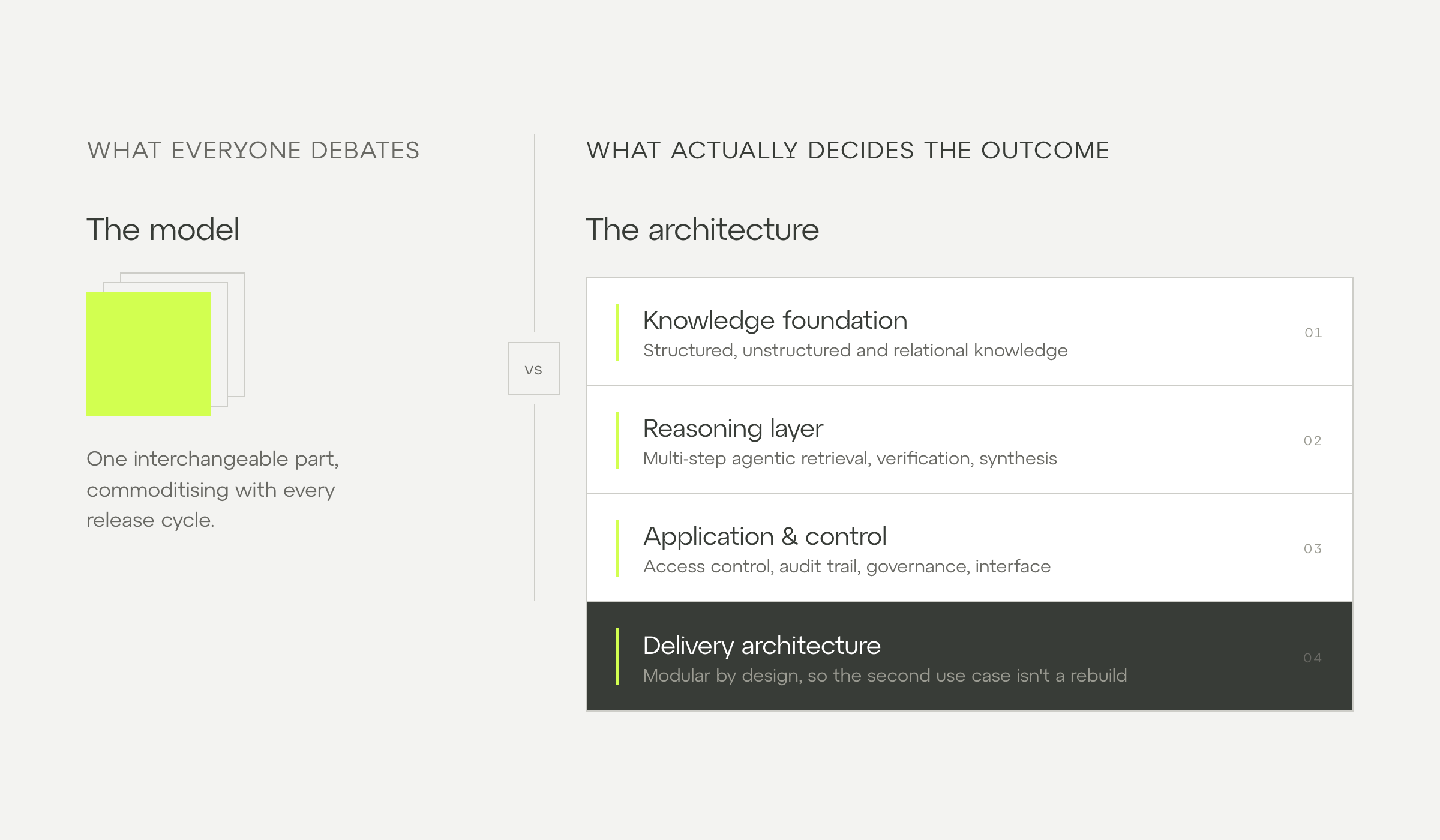
The conversation most organisations are having about enterprise AI is focused on the wrong variable. Which model should we use? OpenAI or Anthropic? Azure or Google? Open source or proprietary? These are real questions, and they matter at the margin. But they are rarely what determines whether an AI programme delivers meaningful, scalable results.
Models are commoditising rapidly. The performance gap between leading options narrows with every release cycle. What does not commoditise at the same pace is the architecture that sits around the model: the infrastructure that determines what the AI can access, how it reasons, how it connects to users, and how the organisation maintains control over what it does. That is where most enterprise programmes hit their ceiling, and that is where the investment conversation needs to shift.
The pilot trap
Most large organisations have run AI pilots. Fewer have moved those pilots into production. Fewer still have scaled them across the business into something that functions as a genuine capability rather than a series of disconnected experiments.
What we see, consistently, is the same sequence. A pilot gets funded, it works well enough in a controlled environment, it goes to production, and then something breaks. The answers become inconsistent. Users encounter errors they cannot explain. Confidence drops. Adoption stalls. A second pilot is commissioned to try a different approach, and the cycle repeats.
The diagnosis is usually the same. The pilot was built as a point solution: a model connected directly to a limited set of documents, optimised to answer a narrow set of questions in a controlled environment. When the real world introduces messier data, more complex queries, more demanding users, and harder governance requirements, it falls apart. Not because the model was wrong. Because the architecture was never designed to hold.
This is not a failure of ambition or investment. It is a structural problem that emerges from treating AI as a product to buy rather than a capability to build. The organisations that move past the pilot stage consistently share one characteristic: they made deliberate architectural decisions before they started building, not after.
What architecture actually means
Enterprise AI architecture is not a single technology decision. It is a set of structural choices about how four distinct layers are built and connected. Each layer has its own failure mode. And each one needs to be designed deliberately, because the defaults that come with most off-the-shelf AI platforms are not optimised for the complexity of real enterprise deployment.
The knowledge foundation
The first layer is the knowledge foundation: how organisational data is structured, stored, and made accessible to the AI.
This sits on top of the data the organisation already has: existing systems, data platforms, files, and documents. The question isn't whether to build a data layer from scratch. It's whether what you already have is structured in a way the AI can reason across. Most organisations discover the answer to that only after they have started building. Most enterprise AI implementations access only a fraction of what the organisation actually knows. They can search documents. They can find relevant paragraphs. But they cannot answer questions that require connecting information across different types of knowledge, and those are precisely the questions that drive real decisions.
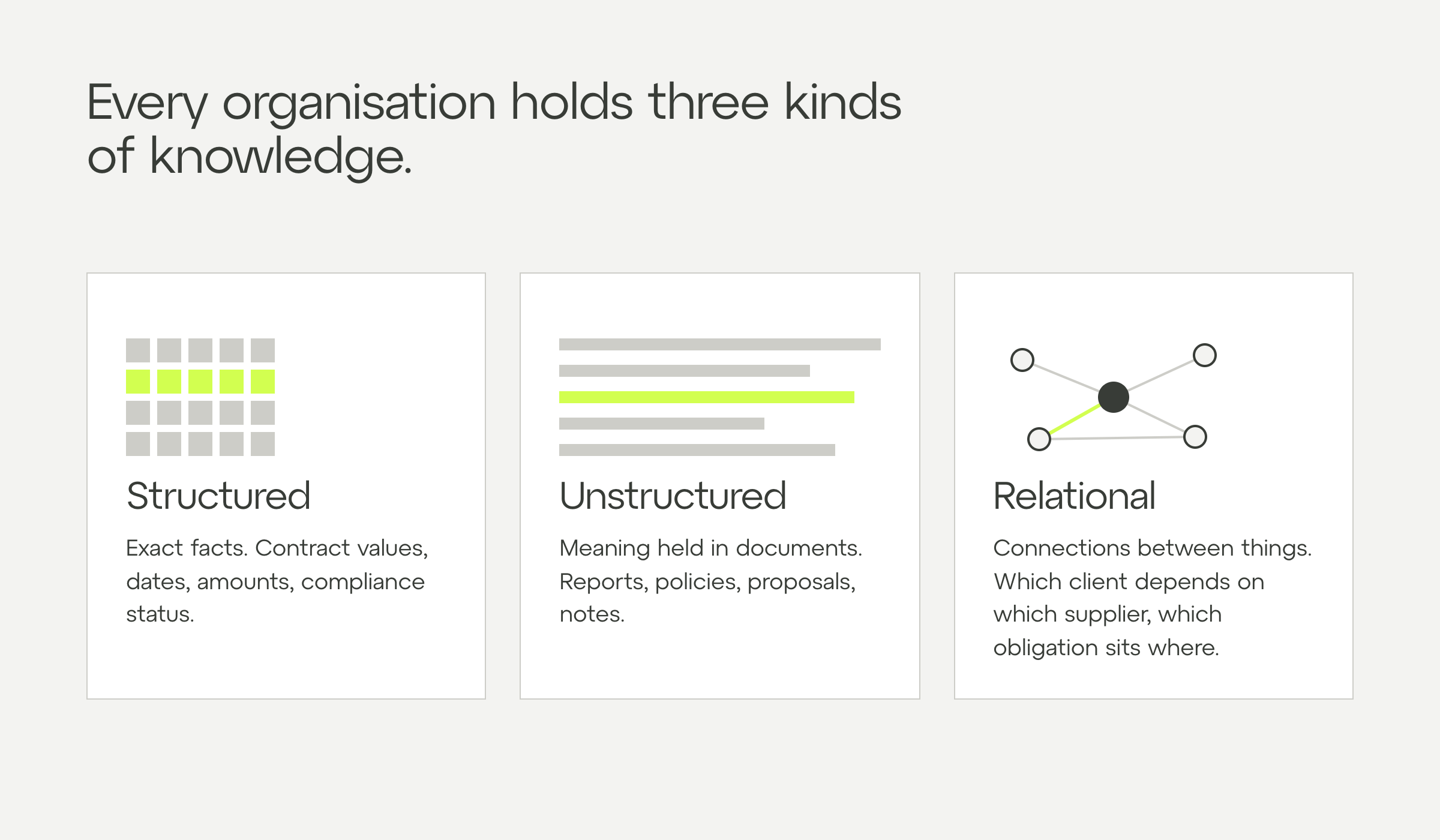
Every organisation holds three types of knowledge, and each requires a different storage and retrieval approach. The first is structured knowledge: exact facts stored in databases. Contract values, compliance statuses, SLA terms, financial records, dates and amounts. The second is unstructured knowledge: meaning stored in documents. Reports, policies, proposals, research, meeting notes. Standard retrieval-augmented AI (RAG) handles this reasonably well through semantic search. The third is relational knowledge: the connections between entities. Which clients depend on which suppliers. Which regulatory obligations link to which contracts. Which people hold relationships that create either value or risk. This knowledge lives in no single document. It exists only in the network of relationships between things.
An AI system that can only access documents will miss the relational layer entirely. The organisations getting the most from enterprise AI have built knowledge foundations that handle all three types. In practical terms, this means a triple-store architecture: a relational database for exact facts, a vector database for semantic search across documents, and a graph database for relationship traversal. Each store handles a different type of query. A well-designed system routes each question to the right store, or combines answers from all three when the question demands it.
The difference in output quality between a single-store and triple-store approach is not marginal. For simple factual questions, a single store may be sufficient. For the complex, multi-part questions that actually drive business decisions, a triple-store architecture is not an enhancement. It is a prerequisite.
The reasoning layer
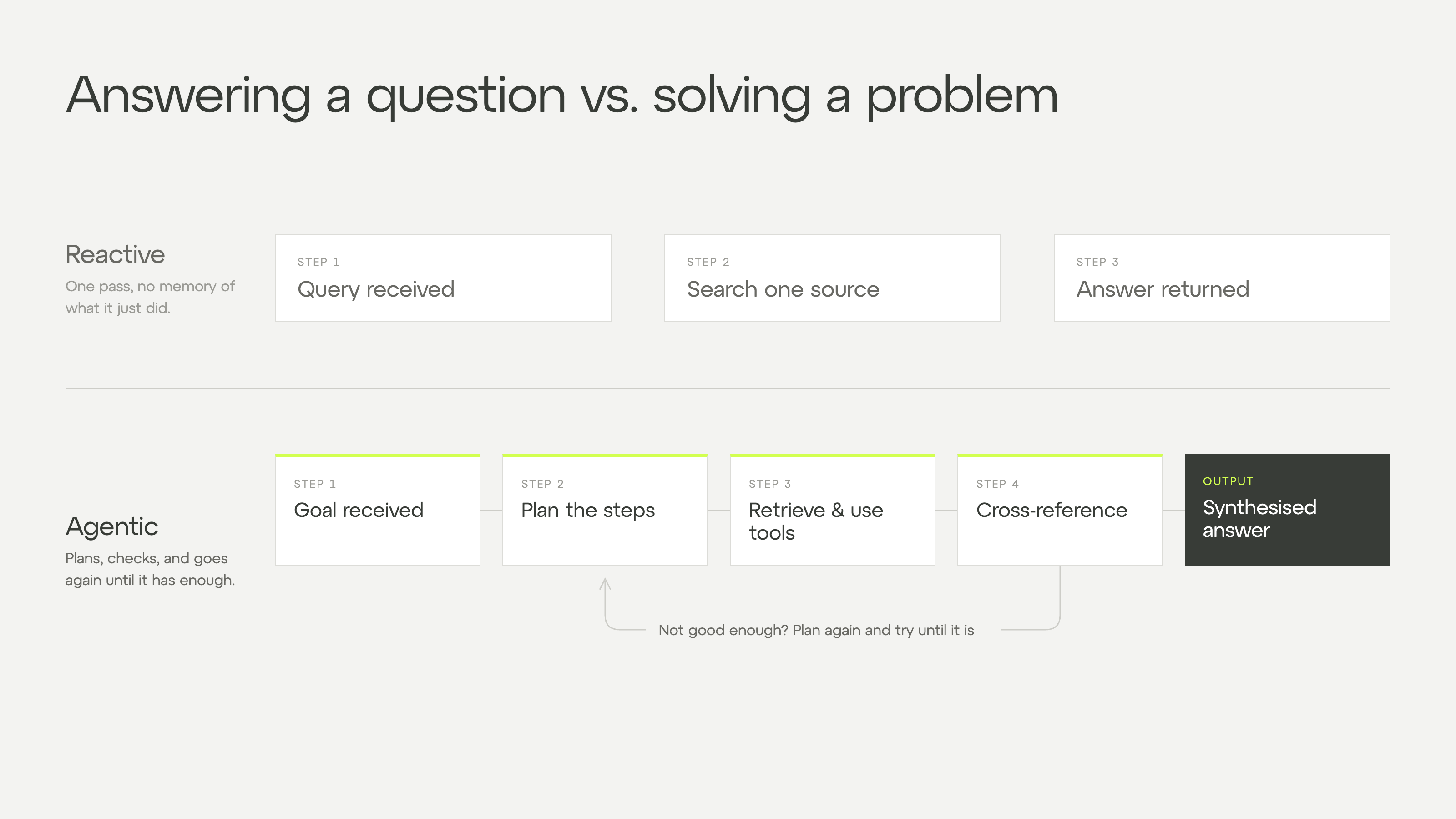
Consider a question a senior decision-maker might genuinely ask: a key contact at an important client has just resigned, and the executive wants to know what the exposure is. A single-step retrieval might return a contract, some email threads, and a client brief. Useful fragments, but not an answer. An agentic reasoning layer does something different: it identifies all active contracts linked to that client, checks their value and renewal timelines, maps the relationships between the departing contact and others in the account, surfaces any known commitments or dependencies, and assembles those threads into a coherent picture of exposure. Not because it is smarter, but because it was designed to reason rather than retrieve.
One thing worth making explicit: a well-built reasoning layer doesn't generate answers from thin air. Every claim in the output is grounded in what the system actually retrieved. If the answer isn't in the data, the system says so, and cites what it did find. That's different from a language model producing fluent, confident text based on general training. The trustworthiness of the output comes from the grounding, not from the model.
The second layer is where the AI reasons across the knowledge it can access. This is where the gap between standard retrieval-augmented AI and genuinely capable enterprise AI becomes most visible, and where the architectural investment has the highest return.
Standard RAG works by finding relevant documents and passing them to a language model to synthesise an answer. It is a one-step process: retrieve, then generate. For simple factual questions, this is often sufficient. For complex multi-part questions, it consistently falls short.
The limitation is structural. A single retrieval step cannot handle questions that require sequential reasoning: find the answer to part A, use that to determine what to look for in part B, then combine both to arrive at a coherent response. Those are the questions that matter most to senior decision-makers. They are not asking for document summaries. They are asking for analysis that draws on multiple data sources, resolves contradictions, checks consistency, and arrives at a conclusion with supporting evidence.
A properly designed reasoning layer uses an agentic architecture: a multi-step process in which the AI breaks down the question, selects the appropriate retrieval strategy for each component, executes the steps in sequence, verifies the results, and then synthesises a coherent answer. This is not a marginal performance improvement. It is a qualitative shift in what the system can do.
It's worth being honest about the trade-off: agentic reasoning takes more time and compute than a single retrieval step. A well-designed system accounts for this by routing questions intelligently: straightforward factual queries go the direct route, fast and cheap; complex multi-part questions go the agentic route, where the extra cost is justified by the quality of the answer. The two approaches aren't competing. They work together.
The application and control layer
The third layer is where AI connects to users and where the organisation maintains control over what it does. This layer is consistently underinvested in enterprise AI programmes, and it is consistently where governance failures emerge.
A production AI system needs more than a good answer. It needs a controlled interface that manages who can access what, an audit trail that records what was asked and what was returned, and a governance model that allows the organisation to verify, correct, and improve the system over time.
Role-based access control matters because not every user should have access to every piece of organisational knowledge. An AI that treats all users as equally privileged creates data exposure risks that no organisation would accept from any other enterprise system. The application layer needs to enforce the same information boundaries that exist across the rest of the organisation.
The audit trail matters because AI outputs need to be traceable. When a decision is influenced by AI-generated analysis, someone needs to be able to reconstruct what the system accessed, how it reasoned, and why it produced the answer it did. Without that traceability, accountability is impossible, compliance obligations are difficult to meet, and errors are hard to diagnose. In regulated industries, this is not optional. In any industry, it is the difference between a system the organisation can stand behind and one it has to apologise for.
Organisations that deploy AI without adequate application and control layers often discover the gap during an incident rather than during planning. By that point, the remediation cost is significantly higher than it would have been if the layer had been built from the start.
The delivery architecture
The fourth layer is structural: how the system is designed to grow beyond its first use case.
Most enterprise AI programmes begin with a single, well-defined use case. If it succeeds, pressure immediately builds to extend AI to adjacent domains. This is a natural and desirable trajectory. What makes it expensive is when the system was not designed to support it.
A monolithic architecture, built as an integrated solution optimised for one purpose, creates two paths when the second use case arrives: rebuild the system with a broader brief, or build a second parallel system that shares none of the infrastructure with the first. Both are expensive.
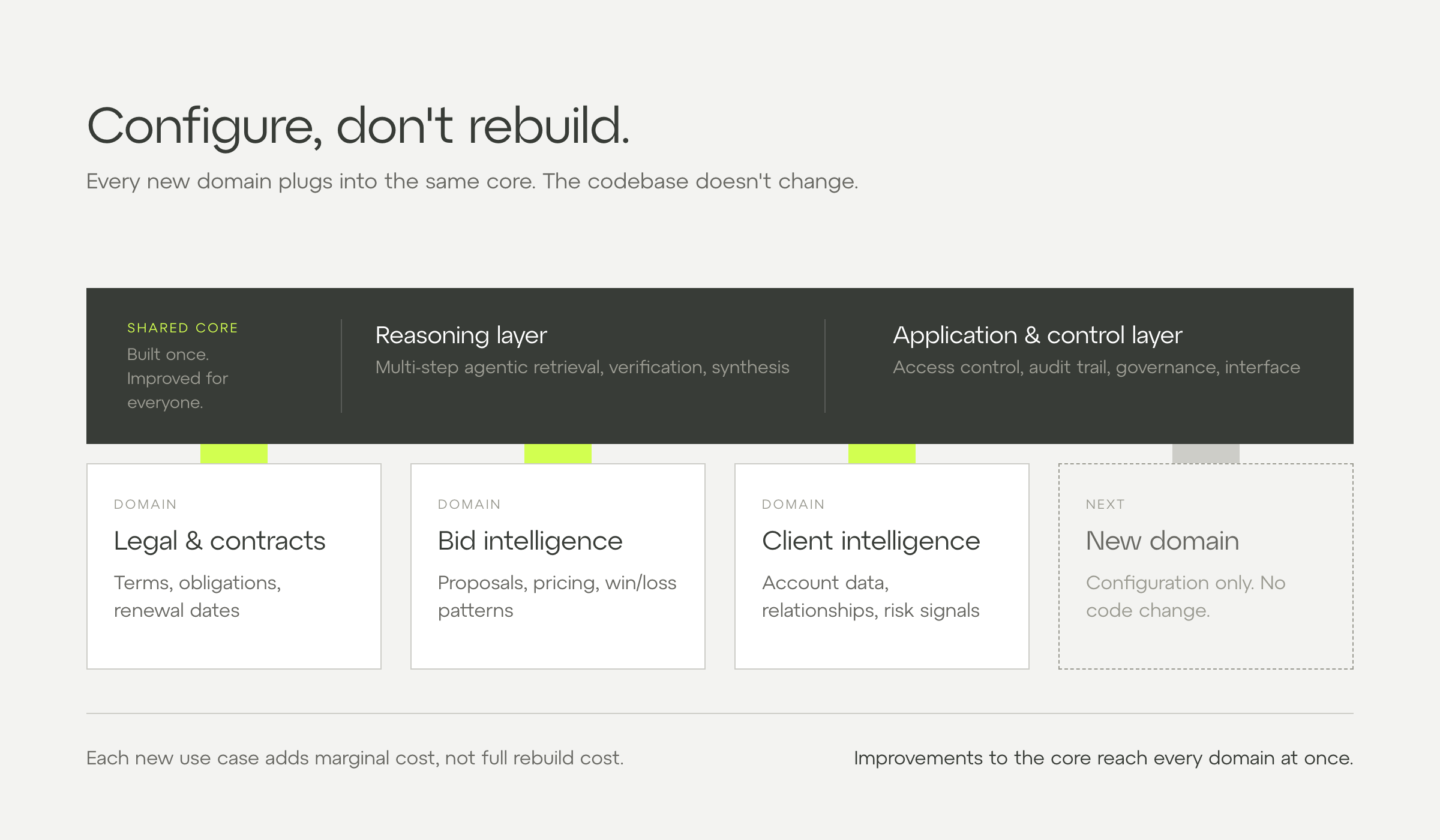
A modular architecture separates the core components from the domain-specific content that populates them. The knowledge foundation, reasoning layer, and application layer are shared infrastructure. A new use case means a new domain-isolated knowledge base, configured for its specific data and query patterns, but connected to the same core. Configuration drives domain-specific behaviour. The codebase does not need to change for every new deployment.
The compounding value of this approach is significant. Improvements to the core reasoning layer benefit every domain without re-deployment. Each new use case adds marginal cost rather than full rebuild cost. The organisation accumulates a portfolio of AI capabilities rather than a collection of disconnected experiments.
What goes wrong without each layer
The failure modes are predictable once you know what to look for.
Without a proper knowledge foundation, the AI produces confident-sounding answers based on an incomplete picture of organisational knowledge. It can access documents but not relationships. Users encounter errors they cannot diagnose and lose confidence in the system. This is worse than no system at all, because an absent system does not actively mislead.
Without a capable reasoning layer, the system performs adequately on simple questions and falls apart on complex ones. The highest-value applications remain permanently out of reach. The organisation ends up with an expensive document search tool.
Without the application and control layer, the system creates governance risk that compounds over time. No one can account for what the AI accessed, who accessed it, or why it said what it said.
Without a modular delivery architecture, the organisation builds a capability that is expensive to extend and difficult to improve. Every new use case becomes a new project rather than a configuration exercise.
What this means for organisations building AI today
The organisations seeing the clearest returns from enterprise AI are not necessarily the ones with access to the most powerful models. They are the ones whose architecture was built to handle the full scope of what production AI demands: a knowledge foundation that covers all three types of organisational knowledge, a reasoning layer designed for multi-step complex queries, an application layer with the governance controls that production deployment requires, and a delivery architecture that scales without rebuild.
The practical implication is that architecture decisions made early are difficult and expensive to reverse. A point solution built quickly to prove a concept will rarely survive intact to production at scale. An architecture built to support growth from the outset compounds in value as use cases are added.
This is not an argument for building everything before starting. Discovery work (validating the knowledge foundation and reasoning approach against a narrow, well-defined use case) is the right first step. But the structural decisions need to happen during that discovery phase, not after the first production deployment has locked in choices that are now expensive to change.
The question worth asking before commissioning an AI programme is not which model to use. It is four questions: Does the knowledge foundation handle structured, semantic, and relational knowledge? Does the reasoning layer handle multi-step queries? Do we have the application controls needed for production governance? And can the delivery architecture extend to a second use case without rebuilding the first?
If the answer to any of those is no, the model choice is a secondary problem. The architecture is the work.
About the author

Bjarne Christiansen
Senior AI Architect