
Every enterprise AI assistant demos well. They all answer questions, draft text, and search across your tools. So the comparison that matters isn't the chat box – it's everything behind it: where your data lives, who can see what, whether the assistant actually knows your business, and whether you're locked to one vendor's model. Those are the questions that decide whether a rollout is safe to run and useful enough that people keep using it.
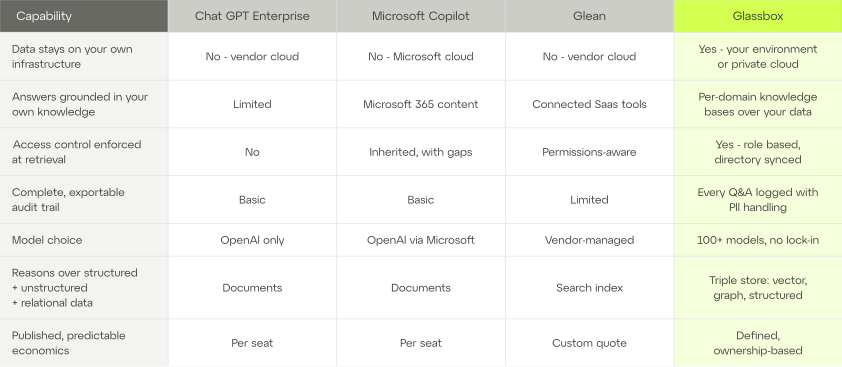
Here's how Glassbox compares with the assistants most enterprises evaluate.
At a glance
What the table actually means
Your data, your rules. The biggest division in the market isn't feature depth – it's where your knowledge ends up. ChatGPT Enterprise, Copilot, and Glean all run in someone else's cloud; useful, but it means your contracts, claims, and customer data leave your environment to be answered. Glassbox runs in your own infrastructure or private cloud, so the data never leaves the building. For regulated industries, that's often the difference between a pilot that ships and one that stalls in review.
Knowing your business, not just searching it. Generic assistants retrieve documents. That's why they so often return something topically relevant but not actually correct — the right document, the wrong answer. Glassbox is built on a triple data store that combines semantic search, a knowledge graph, and structured queries, so it can reason over how things in your business relate, not just match keywords. The result is answers grounded in what your organisation actually knows.
Permissions that hold up. When an assistant can read across everything, your existing data permissions stop applying unless something re-enforces them. Most tools apply access loosely, and the “EchoLeak” class of vulnerabilities showed how that can be exploited. Glassbox enforces role-based access at the point of retrieval, synced to your directory, so people only ever see what they're already cleared to see – and every interaction is logged.
No lock-in. The model landscape shifts every few months. Tying your assistant to a single vendor's model means re-platforming when the leader changes. Glassbox is model-agnostic – over 100 models, swapped as the landscape moves, without rebuilding what sits around them.
When each is the right call
This isn't a case for pretending the others have no place. If your world is entirely inside Microsoft 365 and the data sensitivity is low, Copilot is a reasonable fit. If you mainly need broad drafting and reasoning for general work, ChatGPT Enterprise is strong. If you want fast search across many SaaS tools and your governance bar is moderate, Glean does that well.
Glassbox is the right call when the answer to any of these is yes: your data can't leave your environment, your access rules have to be enforced rather than assumed, you need a real audit trail, or you want the assistant to genuinely understand your business rather than search around it. That's most regulated and complex enterprises – and it's exactly the gap the generic assistants leave open.
See how Glassbox behaves on a governed knowledge base – answers, permissions, and audit trail in action. Book a Glassbox demo.