
IT operations stakeholders within Tier I commercial and investment banks (CIBs) are frequently observed facing an acute architectural dilemma:
- core platforms are indispensable, authoritative engines for capital markets trading, treasury, risk and core banking operations;
- however, those environments were built for batch processing and transactional integrity rather than high-velocity REST or GraphQL Cloud APIs; thus
- attempting to connect modern digital channels, AI services and fintech ecosystems directly to core transactional databases can threaten system stability, trigger performance bottlenecks and – in certain instances – potentially violate operational resilience mandates under the EU’s Digital Operational Resilience Act (DORA).
Conversely, attempting a so-called ‘big bang’ replacement of established core platforms can introduce transformation risk, immense financial expenditure and business disruption.
IT executives are therefore shifting toward modular integration fabrics. By establishing Cloud-native API abstractions, anti-corruption layers (ACLs) and resilient event-driven architectures, leading financial institutions are successfully bridging monolithic core engines with agile Cloud services, thus decoupling client-facing innovation from core operational lifecycles without compromising data integrity.
Empirical Evidence & Synthesis
The dilemma set out above is, at its core, a question of evidence: can core platforms be connected to Cloud services without destabilising the systems they were built to protect and without the transformation risk of wholesale replacement?
A review of published reference architectures, vendor-supported integration models and production field data from capital markets institutions suggests that it can if integration is treated as a structured boundary rather than a series of point-to-point connections.
The synthesis is organised in three parts:
- The reference architecture that separates ingress, command and read paths;
- The four design patterns that manage the mismatch between distributed Cloud APIs and transactional cores; and
- The benchmark results reported by one CIB and one exchange-group operator.
Taken together, they indicate that decoupling client-facing innovation from the core operational lifecycle is achievable incrementally.
1. The Reference Architecture for Core-to-Cloud Integration
Field evidence and architectural frameworks demonstrate that bridging core engines such as Murex or Avaloq with modern Cloud APIs requires a structured multi-tier integration boundary rather than direct point-to-point connections (see Figure 1).
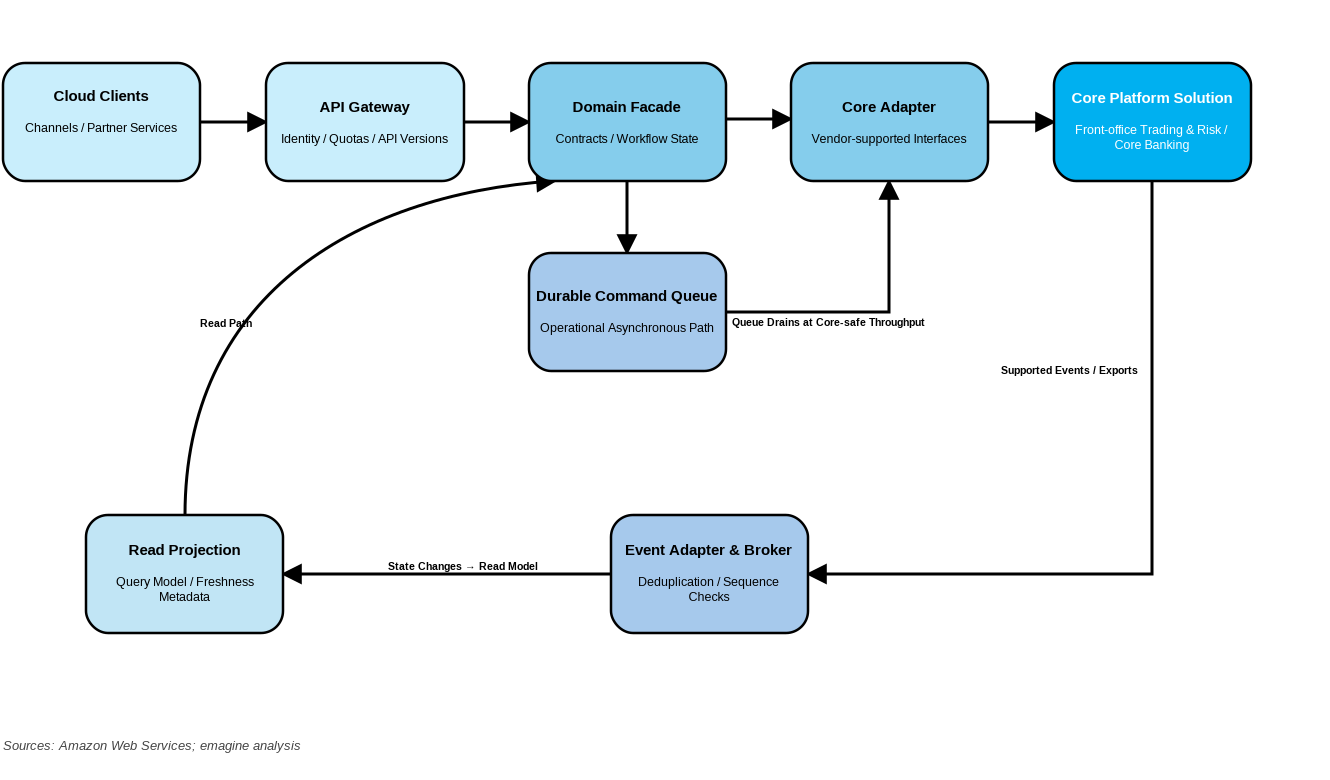
As detailed in industry reference models, this composite architecture establishes distinct operational boundaries:
- Ingress & Domain Abstraction – External requests enter through an API gateway handling identity, rate limiting and version control, before passing to a domain facade that encapsulates enterprise workflow state and API contracts;
- Decoupled Command Path – To prevent incoming API traffic spikes from saturating core engines, commands pass through a core adapter utilising vendor-supported interfaces or buffer through a durable command queue that drains at core-safe processing rates; and
- Asynchronous Read Path (CQRS) – Rather than querying core transactional databases directly for client reads, state changes emitted by core platforms pass through an event adapter and message broker – handling deduplication and sequence checks – to populate a specialised read projection with freshness metadata. The domain facade serves read requests directly from this query model.
2. Core Architectural Patterns & Risk Mitigation Strategies
To handle the structural mismatches between distributed Cloud APIs and banking cores, enterprise architects employ four primary design patterns. Specifically:
- An ACL – When migrating or wrapping legacy functionality, an ACL translates domain model semantics between modern API contracts and upstream core system interfaces. This prevents legacy data structures from ‘corrupting’ modern Cloud microservices and insulates client applications from back-end schema updates;
- Saga Orchestration – Distributed transactions spanning Cloud microservices and legacy databases cannot rely on traditional Two-Phase Commit protocols due to performance and locking limitations. Using saga orchestration, a central orchestrator coordinates sequential local transactions and executes predefined compensating transactions – that is, backward recovery – if a step fails, guaranteeing eventual consistency across heterogeneous data stores;
- Transactional Outbox Pattern – To prevent data inconsistency caused by ‘dual write’ failures – for example, a database write succeeds but event notification fails – state modifications and outgoing events are written atomically to a local database outbox table before an asynchronous message relay publishes them to external brokers; and
- Idempotency Guards – Modern API environments must withstand network retries without executing duplicate financial transactions. Implementing unique idempotency keys at API gateways and core adapters ensures that re-transmitted requests yield identical outcomes without duplicate execution.
3. Empirical Industry Benchmarks: The Rabobank & SaaS Re-platforming Evidence
Production field data from one CIB and one exchange-group operator confirms the measurable benefits of structured core modernisation. Specifically:
- Core Rationalisation at Rabobank – Rabobank replaced 25 fragmented legacy systems across FX, rates, P&L control, risk management and accounting with a single integrated Murex MX.3 platform across Treasury and Markets. By adhering to an 80 / 20 standardisation rule – thus limiting custom software extensions to just 20% of unique business processes – Rabobank eliminated labour-intensive multi-system reconciliations;
- Continuous Integration & Automated Delivery – By implementing Configuration-as-Code, Infrastructure-as-Code and automated Continuous Integration / Continuous Delivery / Continuous Deployment pipelines on AWS, Rabobank automated 80% of manual weekend production deployment tasks. This enabled the institution to deliver 400 to 500 product backlog increments per month while maintaining operational stability;
- Lower Marginal Cost for Regulatory Adaptation – Rabobank’s unified platform model drastically lowered the marginal cost of regulatory compliance, enabling rapid deployment of the BCBS’ Fundamental Review of the Trading Book Standardised Approach calculations and IBOR fallbacks because 70% of relevant trade volumes were already consolidated on the platform; and
- Cloud-native Market Data Integration – Major capital markets institutions hosting Murex MX.3 on AWS are leveraging direct Cloud connectivity to providers like London Stock Exchange Group, enabling out-of-the-box streaming market data ingestion without maintenance of on-premises hardware feeds.
Executive Takeaways
For European banking technology leaders evaluating core integration initiatives, empirical research highlights four strategic directives:
- Enforce Strict Domain Isolation via Anti-Corruption Layers – Protect modern Cloud applications from legacy schema dependencies by placing ACLs and domain facades between external API gateways and core engines;
- Implement CQRS to Shield Transactional Core Capacity – Never execute high-volume, real-time query or reporting workloads directly against core transactional databases. Build asynchronous read projections fed by deduplicated event streams;
- Adopt Saga Orchestration for Distributed Transaction Integrity – Replace fragile two-phase commit mechanisms with serverless saga orchestrators that incorporate explicit compensating transactions and idempotency checks; and
- Mandate an 80 / 20 Standardisation Baseline – Restrict custom core developments to the 20% of workflows that provide true competitive differentiation. Utilise vendor-supported APIs and Cloud-native managed services for standard utilities.
From Point-to-Point Connections to Structured Boundaries: The Likely Evolution of Core-to-Cloud Integration to 2029
The evidence reviewed in this article suggests that the central question for CIBs is shifting from whether core platforms can be connected to Cloud services to how consistently the connection can be governed. The Rabobank case indicates that incremental modernisation can sustain delivery at scale. The institution automated 80% of manual weekend deployment tasks and delivered 400 to 500 product backlog increments per month while maintaining operational stability. Over the next one to three years, this experience is likely to move from exception to expectation as DORA resilience requirements and competitive pressure for API-driven innovation converge.
Three developments appear probable. Specifically:
- A structured integration boundary is likely to displace both direct point-to-point connections and 'big bang' replacement as the default approach, with API gateways, domain facades and anti-corruption layers decoupling client-facing innovation from the core operational lifecycle;
- The patterns that manage the mismatch between distributed Cloud APIs and transactional cores may become baseline architectural requirements rather than specialist choices, as CQRS read projections, saga orchestration, transactional outbox and idempotency guards are used to demonstrate operational resilience under DORA; and
- The 80 / 20 standardisation rule is expected to gain wider adoption, with custom development confined to genuinely differentiating workflows and vendor-supported interfaces and Cloud-native managed services used elsewhere, thereby lowering the marginal cost of regulatory change, as the Rabobank case showed.
Taken together, these shifts indicate that the competitive position of a CIB will depend less on whether its core platform is replaced than on the discipline with which that platform is integrated. Institutions that treat integration as a structured boundary, rather than a series of point-to-point connections, are therefore better placed to accelerate innovation without compromising data integrity or operational resilience.