
"Agentic AI" has become one of those terms that gets attached to almost everything. Vendors use it to describe chatbots with slightly more features. Analysts use it to describe an architectural revolution. Business leaders encounter it in strategy documents and are expected to have a view. Most have a reasonable sense that it is significant, and a much less clear sense of what it actually means for them.
The distinction is worth making, precisely because it carries real implications for what to build, what to buy, and where to invest.
What an agent actually is
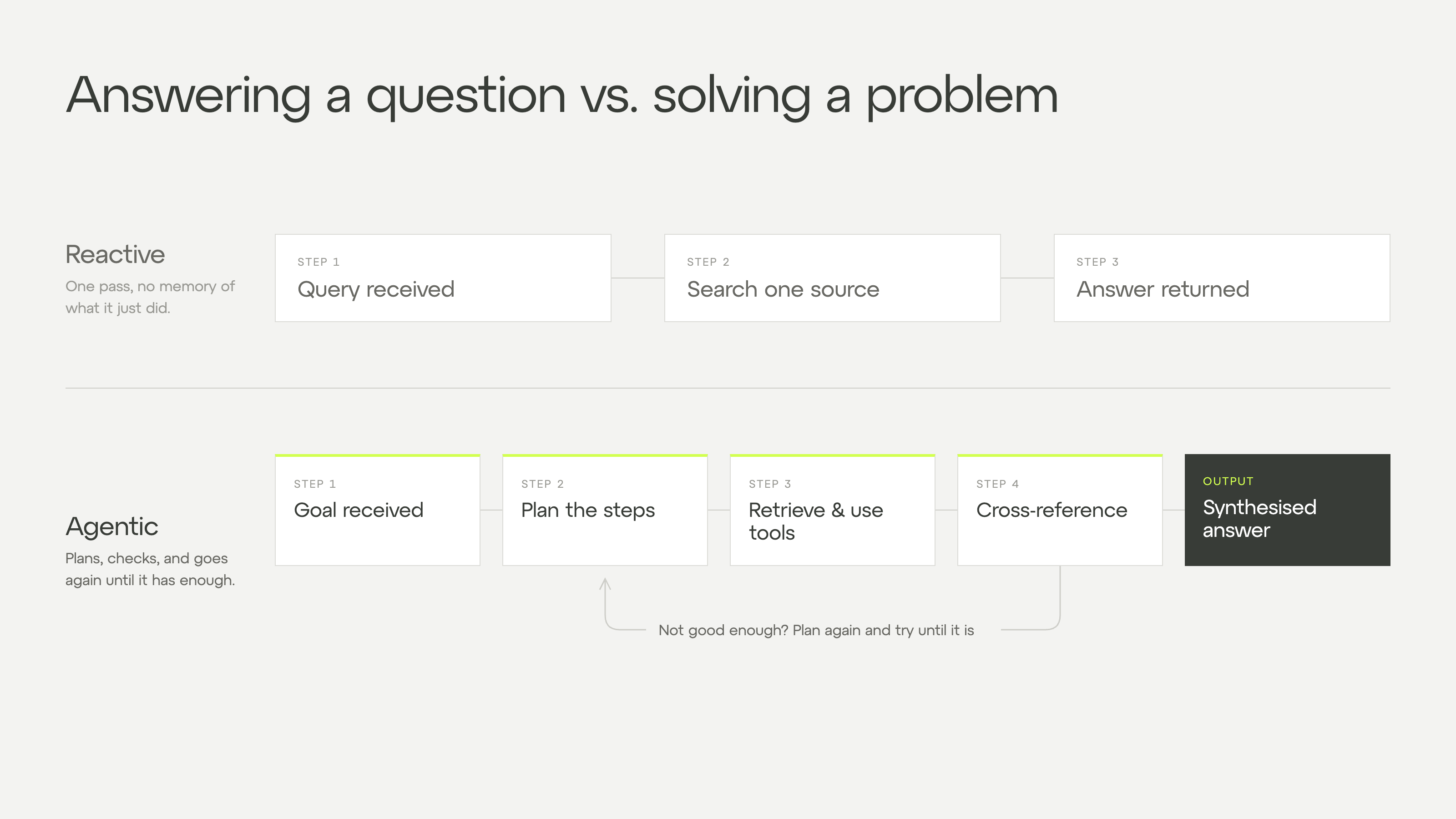
At its simplest, the difference between a standard chatbot and an agentic one is the difference between answering a question and solving a problem.
A standard chatbot responds to what you give it. You provide a query, it searches for relevant information, it returns an answer. Each interaction is self-contained. The system has no awareness of what it did before or what it might need to do next. It is reactive, fast, and well-suited to a specific class of questions.
An agentic system does something different. It takes a goal or question, analyses what would be needed to address it, and plans and executes a series of steps. It might search one source, find a partial answer, decide it needs more context, search another source, cross-reference the results, and synthesise a response that draws on all of it. It reasons about what to do next based on what it has found so far. It can also use external tools (retrieving live data, running calculations, or triggering actions in other systems) as part of reaching an answer.
The core shift is from reactive to deliberate. An agent does not just respond. It works toward an outcome. It not only syntheiszes an asnwer, but can use it to follow-up on much more complex output, and do it iternatively in one run.
Why that distinction matters in practice
Most questions in a business context are not simple retrieval tasks. They are multi-step reasoning problems. "What is our exposure if this client reduces their contract?" requires identifying the contract terms, the revenue involved, any dependencies on related services, and the context of the client relationship. A single-step search returns fragments. A reasoning process connects them to provide a full, coherent answer
This is where agentic AI produces meaningfully better results. Not on straightforward lookups, but on the complex, cross-functional questions that actually drive decisions. We find that agentic retrieval systems consistently shows substantially higher accuracy on multi-step queries compared to classic single-step approaches. The advantage grows as the question becomes more complex.
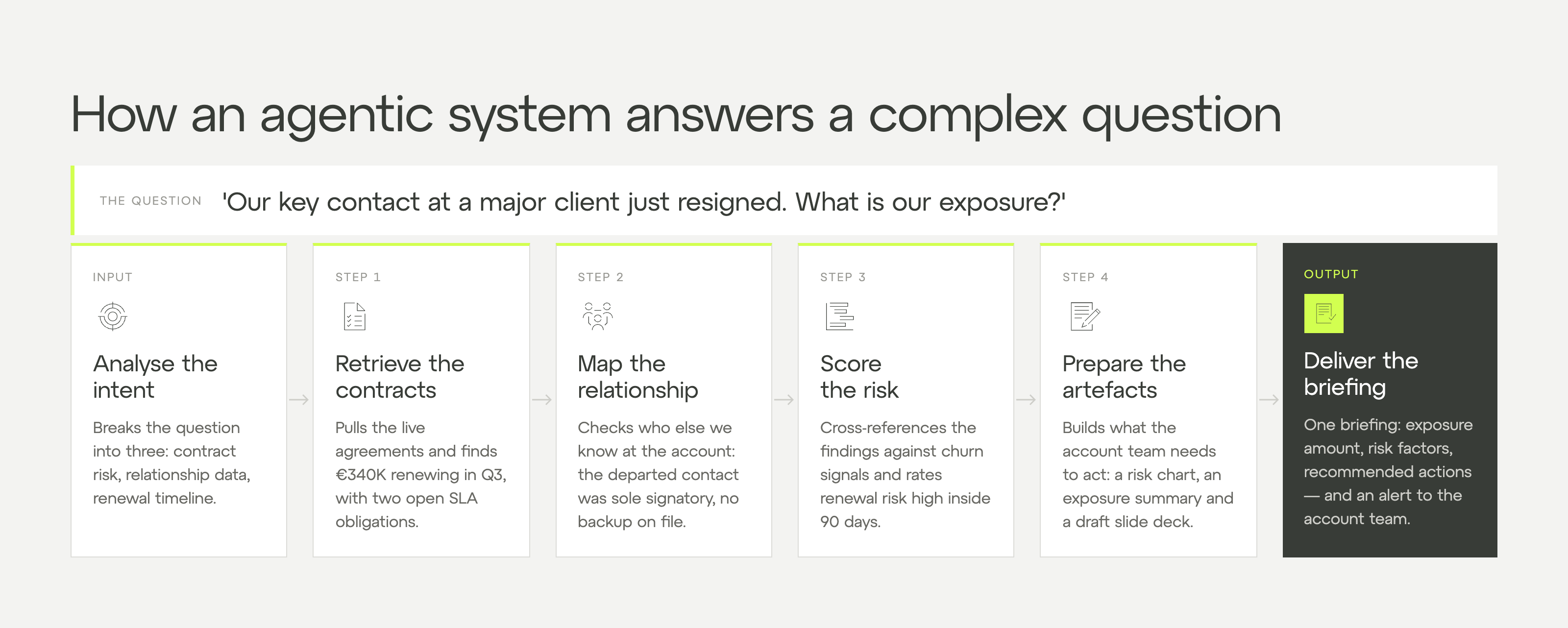
It also matters for workflow automation. An agent that can reason about a goal can take a sequence of actions, not just return information. It can draft a document based on retrieved data, update a record based on a finding, or route a task based on the outcome of an analysis. These are the use cases where AI moves from being a useful reference tool to being part of how work gets done. The output isn't always a text answer. An agent completing a research and reporting task might produce a summary document, a chart, or a draft slide deck alongside its findings - delivered as part of the same workflow.
Where the hype exceeds reality
The more expansive claims about agentic AI (like systems that operate with full autonomy, make consequential decisions without human oversight, and run entire workflows independently) are largely ahead of what is reliably deployable in enterprise settings today.
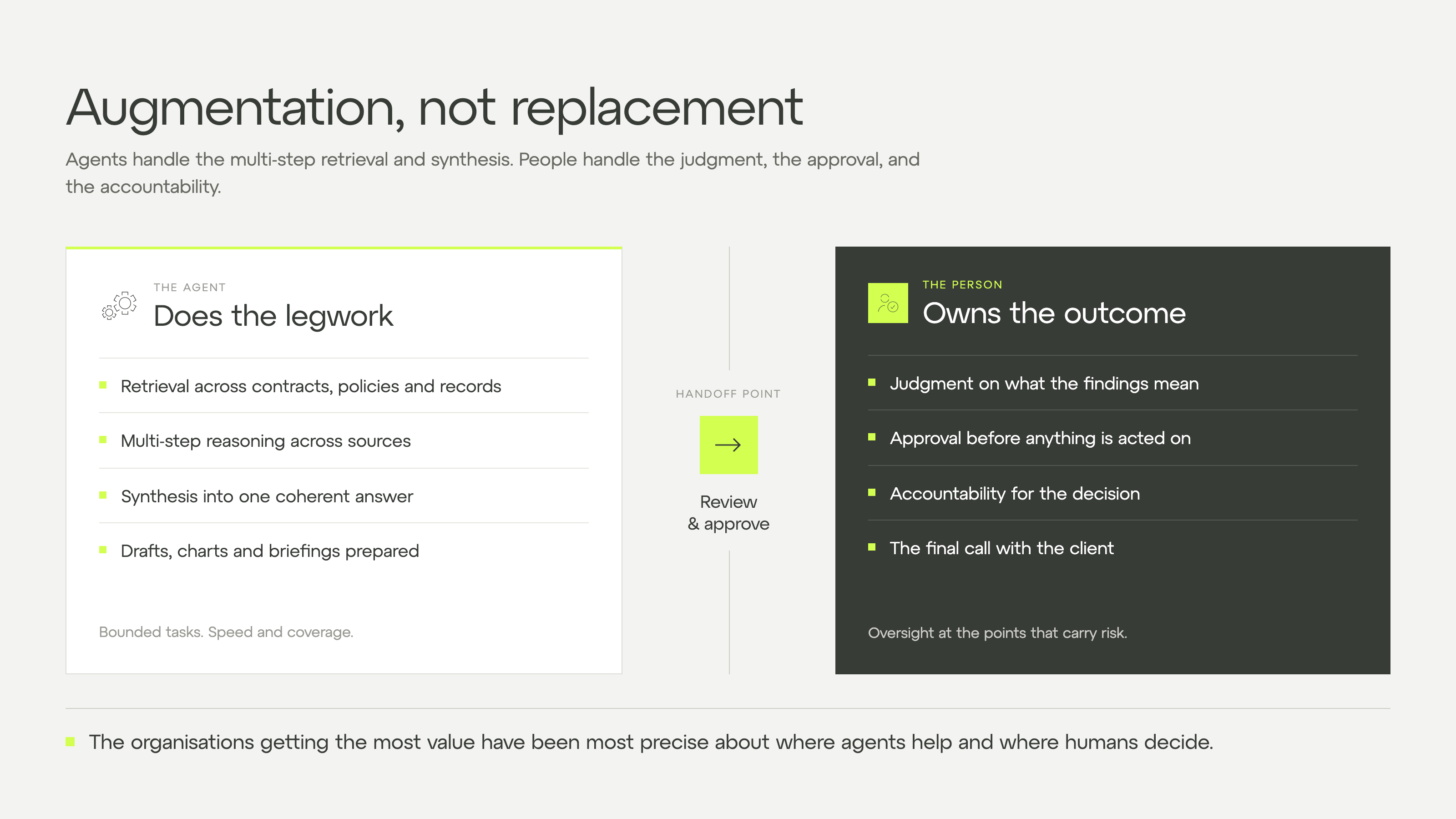
The practical constraints are real. Agents can hallucinate steps as well as facts. They can take a wrong turn in a reasoning chain and produce a confident-sounding but incorrect output. In high-stakes or regulated contexts, the cost of an autonomous error is high. Most enterprise deployments that work well today use agents for bounded tasks with human oversight at key decision points, not for open-ended autonomous operation.
The appropriate frame is augmentation rather than replacement. Agents handle the multi-step retrieval and synthesis. People handle the judgment, the approval, and the accountability. That combination is where the real near-term value sits.
The enterprise use cases worth considering now
Currently most productive applications of agentic AI in enterprise settings share a few characteristics: they involve synthesizing information from multiple sources, they require more than a single retrieval step, and the cost of getting them wrong is noticeable but recoverable.
Knowledge synthesis is a strong fit, pulling together information from contracts, policies, and operational records to answer a complex question. So is document-based analysis, where an agent reviews a large body of material and surfaces relevant findings rather than requiring a person to read through everything. Workflow support tasks, where the agent prepares a structured briefing or draft based on retrieved information and a human reviews before acting, are another productive area.
Where the returns are lower, at least for now, is in fully autonomous decision-making, customer-facing interactions where errors are costly to reputation, and any context where the underlying knowledge base is poorly structured. Agents amplify what they have access to. If the knowledge infrastructure is weak, agentic capability will surface weak answers faster and with more apparent confidence.
What you need in place to benefit
Agentic AI is not a layer you add to an existing system. It requires a knowledge architecture that can support multi-step reasoning. This means structured, well-indexed information in a form the agent can retrieve reliably, query precisely, and traverse across sources.
It also requires clarity about where agents operate with autonomy and where they hand off to a person. The organisations getting the most value from agentic AI today are not the ones who have given agents the most authority. They are the ones who have been most precise about where agents help and where humans decide.
The technical capability is available now. The question is whether the knowledge foundation and the governance model are ready to support it well in your organisation
About the author

Mateusz Kaczorek
Lead AI Engineer
Lead AI Engineer at emagine, specializing in Agentic AI architectures, LLMOps, deployment of large language model and NLP-based solutions in production environments. He has hands-on experience building agentic frameworks and systems that automate business processes using LangGraph, A2A and modern agentic technologies. A three-time Data Science Summit speaker, Google Developer Day speaker, he also authors whitepapers on user-centric AI system design and hosts the 'Talk IT to me' podcast, which explores practical applications of AI agents