
That distinction matters more now. Regulatory expectations around KYC quality governance are moving beyond policy existence towards demonstrable evidence of control effectiveness. Supervisors increasingly want to see how oversight works in practice: how sampling decisions are made, how errors are escalated, how remediation is tracked, and whether governance can scale as volumes, teams and operating models change.
This article is about the mechanics of genuine quality governance in KYC. Specifically, the operational decisions that determine whether an accuracy standard holds over time, at scale, through team changes and under regulatory scrutiny.
The framework applies equally to in-house compliance teams and outsourced ones. The same principles govern both.
First-time-right: What it actually measures
First-time-right is the most commonly cited KYC quality metric - and the most commonly gamed.
It measures the proportion of cases completed accurately without requiring rework or correction before client acceptance. That makes it the clearest single indicator of operational quality in a KYC team. It is also why the calculation needs to be precise.
The key variable is how errors are classified. A simple count treats a missed signature the same as an undetected sanctions hit. A weighted approach, which any rigorous governance framework should use, distinguishes between procedural oversights and regulatory failures, and reflects that difference in the headline figure.
That methodology is increasingly subject to scrutiny. Regulators and internal audit functions want to understand not only the reported FTR rate, but how it was produced. They will look at whether severity weighting is consistent, whether the sampling methodology is defensible, and whether the treatment of rework materially distorts reported quality outcomes.
In other words, FTR should not just be a performance number. It should be a quality measure that can withstand challenge.
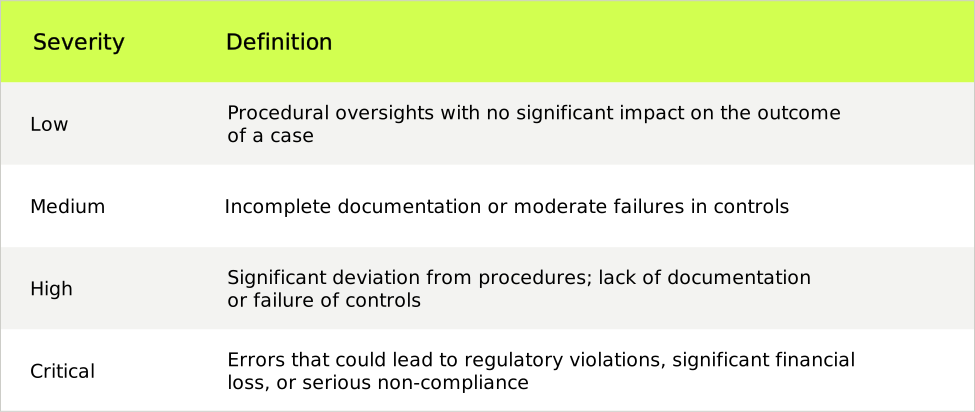
When each severity level carries a different weight in the accuracy calculation, a team can't offset serious quality failures by getting routine cases right. In mature governance models, critical regulatory errors automatically disqualify a case from being treated as first-time-right, regardless of overall case scoring. That matters because the distribution of error types tells a compliance leader more than the aggregate number. A 98% FTR where most errors are low-severity looks very different from a 98% FTR that includes one critical error per hundred cases.
The four decisions that determine whether quality holds
1. The hiring standard
Quality governance catches errors. It doesn't create capability that wasn't hired.
The hiring standard is the first (and most important) quality decision a KYC operation makes. Every subsequent governance mechanism performs better when it's reinforcing a high baseline than when it's compensating for a weak one.
In practice, this means being specific about what "high standard" looks like:
- What technical knowledge is assessed at the point of hire
- How prior track record is verified
- What language standard is required for analysts working with English-language documentation and client-specific procedures
Offshore teams in particular need genuine comprehension, not just functional literacy. Ambiguous case notes and nuanced regulatory guidance can't be processed accurately on surface-level reading.
A higher hiring bar means a smaller talent pool and a longer recruitment process. It also produces lower rework rates and a faster ramp to operational standard. All benefits that compound in quality metrics and client satisfaction over time.
Mature KYC governance frameworks even define accreditation and ongoing competency requirements, including periodic refresher assessments for policy changes, regulatory updates, and high risk case typologies.
2. Sampling that's risk-weighted, not uniform
The purpose of sampling in a KYC operation is to catch quality issues before errors reach the client. A uniform sampling rate (for example, 5% of all cases applied evenly) does that at a surface level. A risk-weighted approach does it more efficiently and more accurately by directing review capacity towards the cases where errors carry the greatest consequence, including sanctions exposure, adverse media escalation trends, politically exposed person cases and jurisdictional risk indicators.
Risk-weighted sampling directs attention where it's most needed:
- Analysts with a declining rolling accuracy rate regardless of the current absolute figure
- Regulated queues, where errors carry higher consequence
- New joiners and cross-trained analysts who haven't yet reached a stable performance baseline
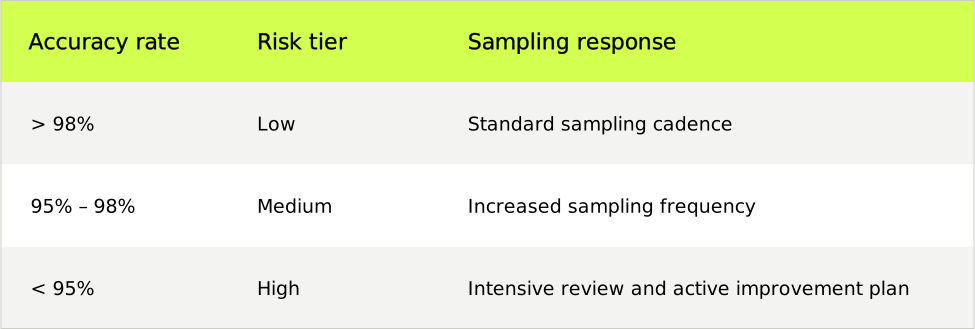
Sampling effectiveness should be periodically recalibrated using error trend analysis, false-positive patterns, and downstream QA findings to ensure governance effort remains aligned to actual operational risk.
Regulated queues carry higher weighting than unregulated ones. New joiners and cross-trained analysts run under enhanced sampling during ramp-up regardless of their previous performance elsewhere.
The result is a sampling model that gives you a more accurate picture of your actual quality risk, with less total sampling overhead than a flat rate.
3. Error handling that's corrective, not just recorded
When an error is identified, the governance response determines whether it gets addressed or accumulated. Two practices separate quality frameworks that genuinely improve over time from those that document without correcting.
The first is a rework commitment with a defined timeline. All rework should be completed within 24 hours of identification, not queued for a weekly review cycle. The analyst gets the case with the error documented, completes the correction, and QC verifies the rework before the case is closed. This keeps corrections happening while the case is still fresh in the analyst's working memory.
The second is root cause analysis (RCA) for significant errors. RCA is the mechanism that turns a one-off mistake into a systemic fix rather than a recurring problem. Effective RCA frameworks distinguish between analyst error, procedural ambiguity, training gaps, tooling limitations, and upstream data quality issues. It documents the issue clearly, assesses operational and regulatory impact, and produces corrective and preventive actions with a defined implementation timeline.
Without RCA, the same error reappears in different cases under different analysts.
A quality framework that records errors without a time-bound correction commitment (or treats RCA as exceptional rather than standard) is primarily a reporting structure, not a control one.
4. Governance that scales with the team
The structure of a KYC team matters as much as the processes inside it.
A common failure mode: governance that works well at launch scale (fifteen analysts, one team lead) and degrades as the team grows because the oversight structure was never designed to scale with it.
Good governance architecture defines what happens to sampling rates, QC resource, and team lead ratios as team size increases. A team lead managing QA for twelve analysts cannot manage the same function for forty without additional resource or a systematic reduction in review quality.
In practice this means a dedicated quality management function that scales deliberately, with sampling frameworks adjusted for larger team sizes, QC resource added proportionally, and team lead structures that maintain meaningful oversight as headcount grows.
A quality rate that holds at twelve analysts and one that holds at fifty are two different things. The governance architecture needs to be designed for both before either becomes necessary.
Additionally, governance should also include structured MI reporting covering error trends, severity distribution, rework ageing, repeat findings, and remediation effectiveness.
What these decisions produce
The four decisions above are not theoretical. They are the governance disciplines our teams have applied in live KYC operations to protect quality as programmes scale, teams change and regulatory expectations increase.
Across managed KYC engagements — including a multi-year financial crime operation at a major bank, a regulatory remediation programme under FCA requirements, and a crypto exchange managing rapid volume growth — this approach helped sustain a first-time-right baseline above 98%. That performance held through analyst turnover, changing case volumes and external scrutiny.
The result came from the operating model behind the number: clear error definitions, risk-weighted sampling, time-bound correction loops and documentation built for review. Together, these controls give compliance leaders confidence that quality is not dependent on individual analysts or short-term mobilisation effort. It is designed into the way the operation runs.
For firms evaluating their own KYC quality framework — whether in-house or outsourced — the headline figure is only the starting point. The real question is whether the methodology behind it can stand up to challenge. That is where strong governance becomes visible.
What to ask of your own team or partner
Whether you're running a KYC operation in-house or assessing an outsourcing partner, the same questions apply:
- Can you show me the error classification methodology and how each severity level affects your aggregate accuracy figure?
- Can you describe your sampling approach? What determines the rate for a given analyst and queue?
- What's your rework commitment in hours?
- When did you last run a root cause analysis, and what changed as a result?
- What does your governance model look like at twice your current team size?
Strong answers indicate a framework built to control quality, not just report it. Vague answers (or answers that don't hold up to follow-up) indicate the inverse.
For a compliance function that sits within your regulatory perimeter, the distinction matters. An outsourced KYC operation is part of your quality picture in the eyes of your regulator. The oversight documentation you can provide for it should be as specific as the oversight you'd expect for an internal team.