
There is a property of large language models that gets underemphasised in most vendor conversations: they are trained on general knowledge up to a certain point, and then frozen. The model that answers questions about your business has no idea your business exists. It does not know your contracts, your clients, your procedures, your pricing, or your internal policies. When it produces an answer that sounds specific to your organisation, it is extrapolating from patterns in its training data, not retrieving a fact from your systems.
This is not a flaw in how language models work. It is simply what they are. The flaw lies in deploying one without understanding it – and in building knowledge infrastructure that does not account for the three distinct ways your organisation’s information is structured.
The bridge between model and knowledge
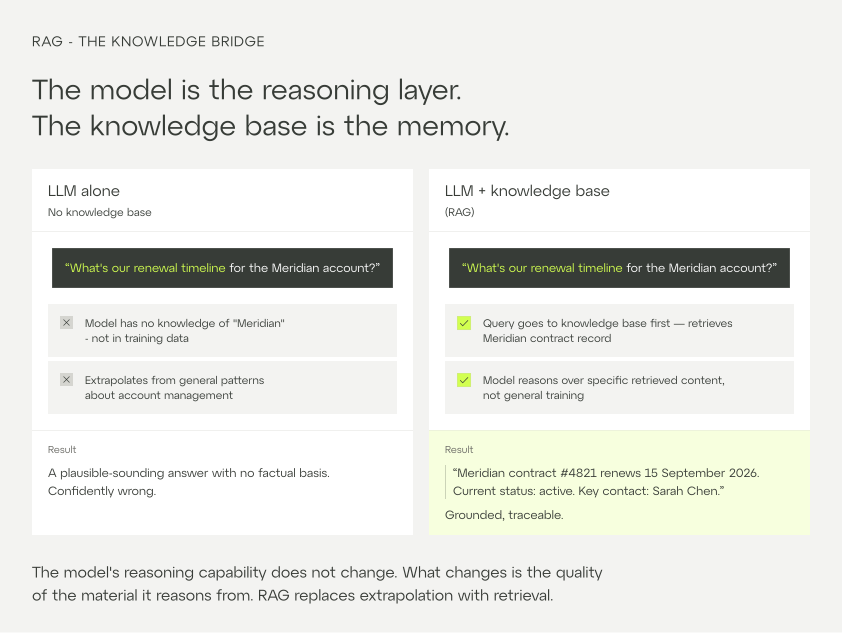
Retrieval-Augmented Generation – RAG – is the technique that addresses the knowledge gap. Rather than relying on the model’s frozen training, a RAG system queries a knowledge base at the moment a question is asked, retrieves the relevant content, and provides it to the model as context. The model then reasons over that content to produce an answer.
Think of it as giving the AI a library card rather than expecting it to have already read every book. When a question arrives, it looks things up rather than recalling from memory.
This changes the quality problem significantly. The model is no longer approximating from general patterns. It is reasoning from specific, current content that reflects your organisation. But the quality of the answers is then directly dependent on the quality of the retrieval – on what the library contains, and how effectively the system can find the right material within it.
A library card is only as useful as the library. A RAG system is only as useful as the knowledge base behind it.
Why one database type is not enough
The conventional assumption in knowledge infrastructure is that you need a database for your data. One store, one interface, one retrieval method. This assumption breaks on the nature of enterprise knowledge itself.
Enterprise knowledge has three fundamentally different dimensions:
- Precise structured facts: contract numbers, dates, statuses, financial figures.
- Conceptual, narrative content: policy documents, meeting notes, case studies, procedural guides.
- Relationships: who connects to whom, which entities share obligations, how a change in one part of the business propagates to others.
No single database type handles all three well. A relational database is excellent for structured lookups but cannot retrieve content by meaning. A vector database is excellent for semantic search but cannot answer “what is the exact status of contract 4821” with structured precision, and cannot traverse a network of relationships. A graph database is built for relationship queries but is not designed for storing and searching large volumes of unstructured text.
The three stores – and what each one answers
A properly built knowledge architecture uses all three simultaneously.
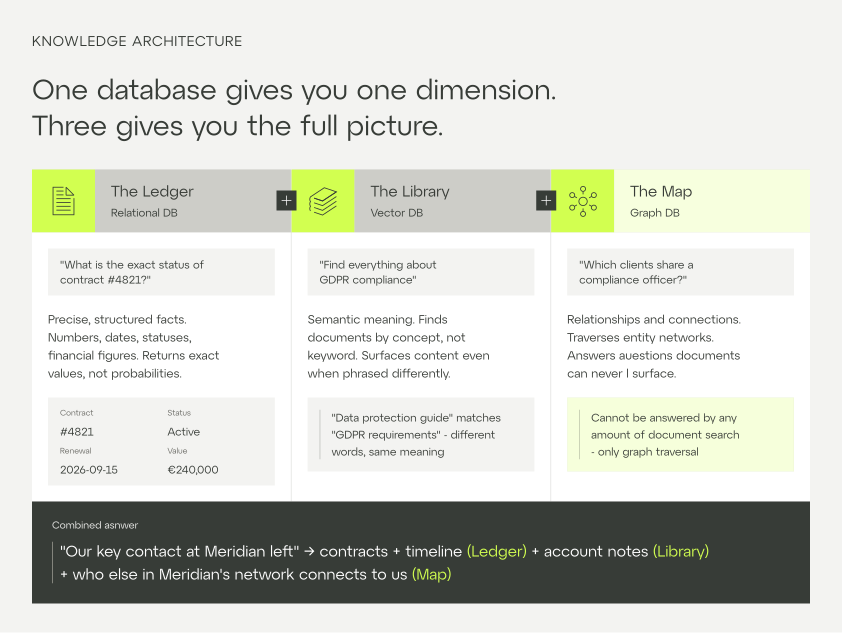
THE LEDGER – the relational store – handles exact, structured facts. When an AI needs to answer “when does this contract expire?” or “what is the current status of this account?”, it queries a structured database that returns a precise value rather than a probability.
THE LIBRARY – the vector store – handles the semantic dimension. When the question is “what do our procedures say about data handling for healthcare clients?”, the system needs to find content by meaning rather than by keyword. The vector database converts text into numerical representations of meaning and retrieves documents that are conceptually relevant, even when the exact words do not match.
THE MAP – the graph store – handles the relational dimension. When the question requires understanding connections between entities – “which clients share a compliance officer?”, “our key contact at Meridian just left: what’s our exposure?” – the system traverses a network of relationships to produce an answer that no amount of document search could surface.
The question that illustrates why all three matter: “Our key contact at Meridian Corp just left. What’s our exposure?” THE LEDGER retrieves the contracts and their renewal timelines. THE LIBRARY retrieves the account notes that describe key dependencies. THE MAP maps who else in Meridian’s network connects to your accounts. Each store contributes a dimension. The AI synthesises them into one answer.
What breaks when the architecture is incomplete
Missing any of the three stores does not produce an AI that says “I don’t know.” It produces one that gives an incomplete answer with confidence. A system built on vector search alone will answer relationship questions with the nearest conceptual match from documents – which may be plausible but is not the same as traversing the actual relationship network. A system built on keyword search will fail entirely on questions phrased differently from the source material.
The failure is invisible precisely because language models are fluent. They produce grammatically coherent, professionally worded responses regardless of whether the underlying retrieval was complete. The only way to detect the gap is to know the correct answer independently – or to build a system that surfaces its sources with enough transparency to check.
The infrastructure question to ask first
When evaluating enterprise AI, the knowledge infrastructure question comes before the model question. The capabilities of a given language model matter less than whether the knowledge retrieval system gives it the right material to reason from.
Three questions are worth asking:
- Does the system store structured data, unstructured content, and entity relationships in appropriate separate stores – or does it treat all knowledge as a single searchable corpus?
- Can the AI query across all three dimensions in a single interaction, or is it limited to one retrieval type?
- When it produces an answer, can you see which stores contributed and what was retrieved?
If the answer to any of these is no – or vague – the architecture needs work before the AI goes anywhere near live data.
An AI that reasons brilliantly from incomplete knowledge produces answers that feel authoritative and are structurally wrong. The architecture problem is not one of language models. It is one of what you give the model to work with.
About the author

Mateusz Kaczorek
Lead AI Engineer at emagine
Lead AI Engineer at emagine, specializing in Agentic AI architectures, LLMOps, deployment of large language model and NLP-based solutions in production environments. He has hands-on experience building agentic frameworks and systems that automate business processes using LangGraph, A2A and modern agentic technologies. A three-time Data Science Summit speaker, Google Developer Day speaker, he also authors whitepapers on user-centric AI system design and hosts the 'Talk IT to me' podcast, which explores practical applications of AI agents